


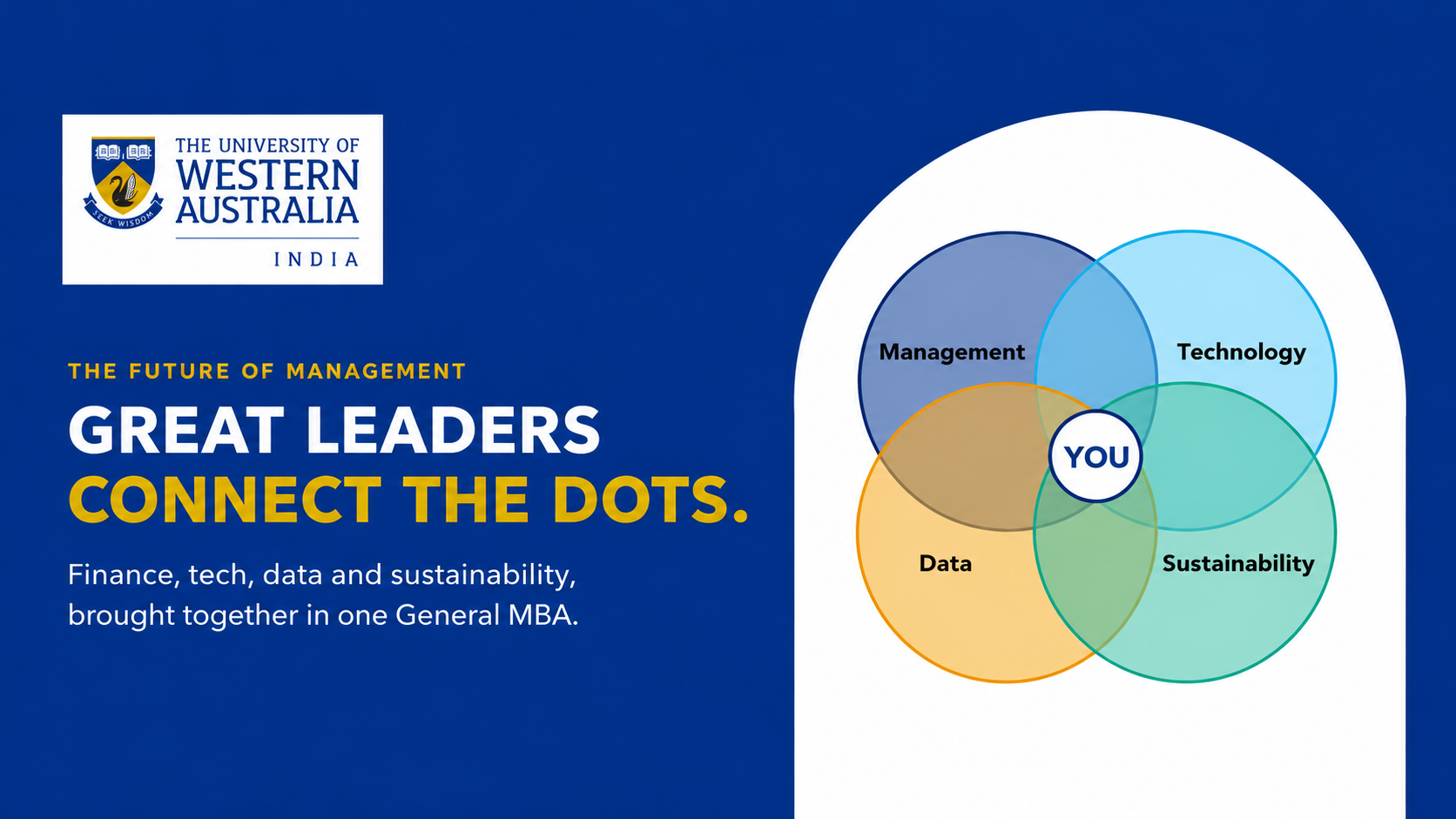
The Future of Management Is Interdisciplinary
For decades, business education organized itself around clean functional lines — finance here, marketing there,
operations somewhere else, each with its own frameworks, its own language, its own experts. That structure made
sense when problems tended to stay inside their lanes. Today, they rarely do.
Where business decisions actually happen now
Consider a straightforward-sounding decision: should a company launch a new product line?. Answering the
question well means understanding the financial case, yes, but also the data infrastructure needed to track
performance, the technology choices that shape what's even possible to build, and the sustainability implications that
increasingly determine regulatory approval, investor interest, and consumer trust. A leader who can only reason
about one of these dimensions isn't equipped to make the call — they're equipped to make part of the call, and hope
someone else covers the rest.
This is the shape of most consequential business decisions today. They sit at the intersection of management,
technology, data, and sustainability, not neatly inside any single one of them.
When silos fail — and when they don't
The cost of staying inside functional lanes is well documented. Kodak didn't fail because it lacked digital camera
technology — it invented it. It failed because that technological insight never fully reached the strategic and
financial decision-makers who were busy protecting a film business. The problem wasn't a lack of expertise in any
one function; it was the absence of someone positioned to connect the dots across the functions.
Contrast that with Unilever's Sustainable Living Plan, which embedded sustainability targets directly into brand
strategy, supply chain decisions, and financial planning rather than treating it as a side initiative run by a separate
team. The brands built around that integration consistently outgrew the rest of the portfolio — not because
sustainability was a nice addition, but because it was woven into the same decisions that finance and strategy were
already making.
The difference between the two cases isn't talent or resources. It's whether someone in the room was responsible
for connecting technology, finance, strategy, and sustainability into one decision instead of four separate ones.
Beyond the silo
None of this means specialization is obsolete. Organizations still need people who go deep — the data scientist, the
sustainability officer, or the finance lead. What's changed is what's expected of the people managing across those
specialists. The manager's job is no longer just to direct a function; it's to synthesize input from multiple functions
into a single coherent decision, often under time pressure and incomplete information.
That requires a different muscle than functional expertise: the ability to collaborate effectively across specialized
teams, to ask the right questions of people who know more than you do about their domain, and to translate between
disciplines that don't naturally speak the same language.
“The best decisions today rarely come from a single discipline. Universities have a responsibility
to build leaders who can connect research, technology and real-world impact — not just
specialists who stay within their lane.”
Prof. Rajaraman Eri, Pro Vice-Chancellor, UWA India
Fluency, not expertise
A natural objection here: does this mean every manager now needs to become a data scientist, or a sustainability
expert, or a technologist? No. The goal isn't technical mastery — it's fluency.
This isn't just intuition — it's increasingly what the research shows. A study of professionals across Indian
multinational IT firms, examining what the AI era actually demands of the workforce, identified five skills as
critical: data analysis, digital fluency, complex cognitive reasoning, decision-making, and continuous learning —
none of which are deep technical specializations on their own, and all of which cut across traditional functional
boundaries (Jaiswal, Arun & Varma, International Journal of Human Resource Management, 2022). The managers
best positioned for what's coming aren't the ones racing to become engineers — they're the ones who can hold their
own in a room with engineers, financial analysts, and sustainability leads at once.
“As technologies such as AI reshape the workplace, managers who thrive won't be the
ones who resist that change or try to master it technically overnight — they'll be the ones who
know how to ask the right questions, work alongside technical experts, and keep people and well-
being at the centre of the decision.”
Prof. Akanksha Jaiswal, PhD, Associate Professor & Acting Head of Department, UWA India
What this means for how MBAs should be built
If this is genuinely the shape of future leadership, business education has to be built to develop it deliberately — not
as an afterthought bolted onto traditional functional courses, but as a core design principle.
A curriculum grounded in accelerated management — covering Economics, Finance, Strategy, Marketing,
HR/OB, and Operations without forcing an early specialization — gives future leaders the full vocabulary they'll
need to operate across functions. Learning through case studies, projects, industry connects, and research-based
work, rather than rote instruction, mirrors how real interdisciplinary problems actually get solved: messily, with
incomplete information, requiring judgment rather than formula recall. A pedagogy built in a developed market,
applied in the context of a developing one, forces students to test frameworks against conditions where the
assumptions don't always hold — itself a form of interdisciplinary, cross-context thinking.
The takeaway
Interdisciplinary thinking isn't the next competitive edge in management — it's will soon become the entry
requirement. The leaders who still define themselves by a single function — the “finance person,” the “marketing
person” — won't just be less effective rather in a decade, they'll struggle to get into the room at all. The real
question for every rising manager is how to broaden and build their thinking to elevate decision making.